Petri net
Reaction network \((S, T, s, t)\)
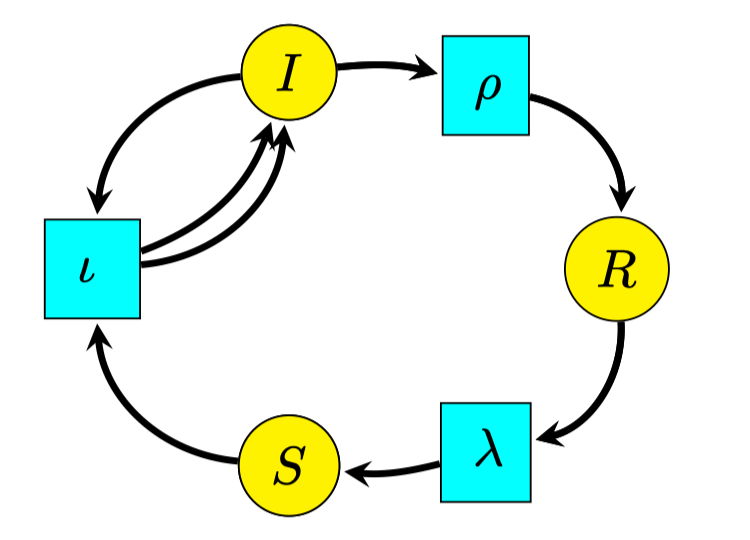
- Eg: SIRS infectious disease model
- \(S + I \xrightarrow{\iota} 2I\)
- \(I \xrightarrow{\rho} R \xrightarrow{\lambda} S\)
- species:
- \(S\): susceptible
- \(I\): infected
- \(R\): resistant
- reactions:
- \(\iota\): infection
- \(\rho\): recovery
- \(\lambda\): loss of resistance
- definition:
- a finite set of species
- reactions go between "complexes", which is finite linear combinations of these species with natural number coefficients
- rate constant and rate equation:
- rate constant: a positive number called can be attached to each reaction
- rate equation: now a reaction network determines a system of differential equations saying how the concentrations of the species change over time
- Eg
- \(\frac{dS}{dt} = r_\lambda R-r_\iota SI\)
- \(\frac{dI}{dt}=r_\iota SI-r_\rho I\)
- \(\frac{dR}{dt} = r_\rho I-r_\lambda R\)
- interesting properties:
- existence and uniqueness of steady state solutions
- Mathematics definition:
- consists of:
- a finite set \(S\)
- : elements are called species
- a finite set \(T\)
- : elements are called transitions
- functions \(s, t: T \rightarrow N^S\)
- \(N^S\)'s elements are called complexes, which is finite linear combinations of these species with natural number coefficients.
- any transition \(\tau \in T\) has a source \(s(\tau)\) and a target \(t(\tau)\)
- if \(s(\tau) = \kappa\) and \(t(\tau) = \kappa'\), we write \(\tau: \kappa \rightarrow \kappa'\)
- a finite set \(S\)
- the set of complexes relevant to a given reaction network is
- : \(K = im(s) \cup im(t) \subseteq N^S\)
- graph:
- a reaction network gives a graph
- : vertices set of \(K\)
- : an edge for each transition \(\tau: \kappa \rightarrow \kappa'\)
- it can have multiple edges or self-loops, thus sometimes called:
- a directed multigraph
- or a quiver
- a reaction network gives a graph
- consists of:
Petri Net
- bipartite directed graph
- : 2 kinds of vertices, species and reactions
- : edges
- into a reaction, specifying its input
- out, specifying its output
- Terminology
- in Petri net literature, species are called "places", and reactions are called "transitions"
- so Petri net is sometimes called place-transition net or P/T net
- stochastic Petri net: when each reaction has a rate constant attached
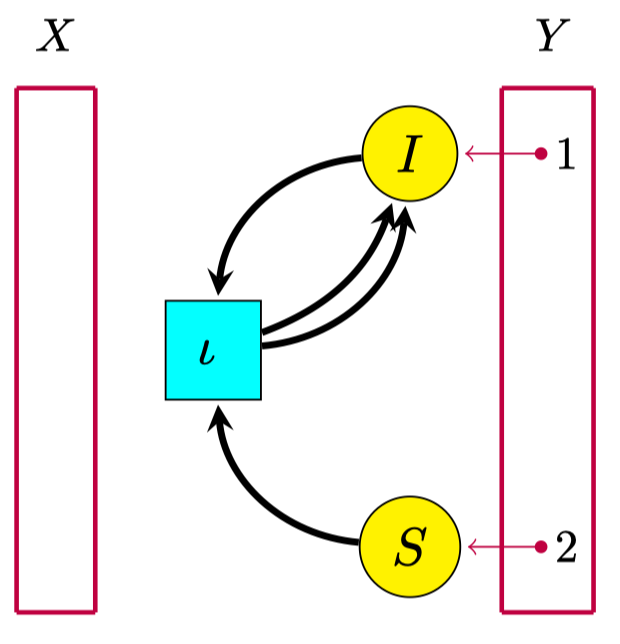
- open Petri net
- inputs and outputs: species can flow in or out
- open rate equation: the usual one with extra terms describing inflows and outflows
Backlinks
A Compositional Framework for Reaction Networks
One can easily turn a [[Petri net#Reaction network \((S, T, s, t)\) | reaction network]] into a Petri net and vice versa.